

FY2021 Management Plan announced
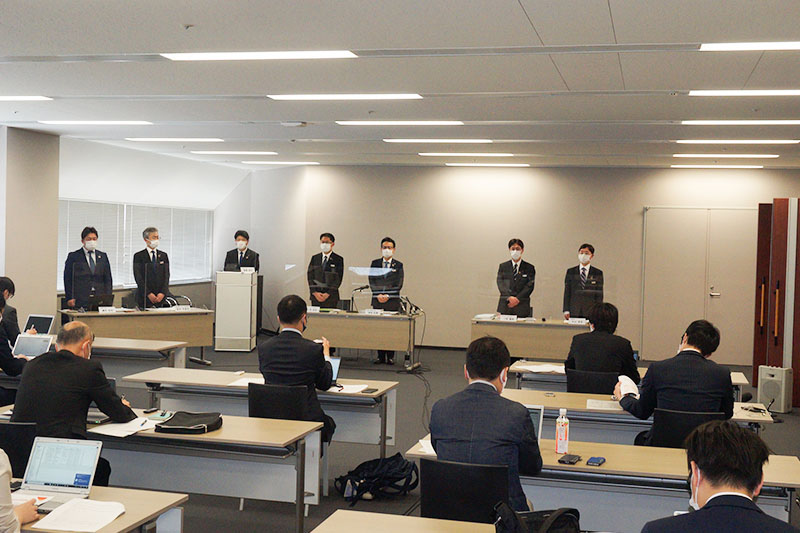
Nankai Electric Railway originally planned to formulate and execute a three-year Medium-term Management Plan. However, the company anticipated a significant reduction in revenue due to the deterioration of our financial foundation caused by the COVID-19 pandemic and other reasons. These included societal changes, such as the advancement of digitalization, and the continued decline in service usage resulting from behavioral shifts. Consequently, the company formulated a single-year FY2021 Management Plan and announced it in April 2021.
In this plan, short-term measures promoted reform of business structure centered on cost reduction, and medium- to long-term measures considered this crisis as an opportunity for transformation. The plan was designed to lay the groundwork for growth (e.g., developing services for the post-COVID era, community development through collaborative creation, and advancing digitalization), in order to achieve both the increase of value as a sustainable company for sustainable management and realization of a sustainable society.
The numerical targets for FY2021 (on a consolidated basis) were set as follows.
- Operating income*:
- 15.0 billion yen
- Net interest-bearing debt:
- 456.0 billion yen
* Operating income + Dividend income
Promotion of sustainability management
To present our commitment to the realization of a sustainable society to our internal and external stakeholders more clearly, the Nankai Group has formulated the Sustainability Policy, and as key long-term measures to be worked on under the Policy, on April 30, 2021, we announced seven major sustainability themes (materiality) that incorporate an SDGs perspective. These themes represented our commitment to continuously tackle social issues through our business activities. The company also set key targets as KPIs, including reversing the demographics from high outflow to high inflow (by FY2027).
Furthermore, to address the initiatives, we have also established the Sustainability Promotion Committee as an organization to drive sustainability measures across the Group, and the Committee has played the central role in setting sustainability targets, monitoring progress, and evaluating outcomes, in collaboration with business divisions.
In January 2022, the company became the first domestic railway company to enter into a financing agreement based on “Positive Impact Finance” with Sumitomo Mitsui Trust Bank. This financing comprehensively analyzes and evaluates both the positive and negative impacts of corporate activities on the environment, society, and economy, and it is intended to provide continued support for such activities.
Additionally, in March 2023, to promote sustainable management and ensure strategic investments, the company established a sustainability finance framework and issued a sustainability bond with a total issuance amount of 10 billion yen and a maturity of 5 years.
1.Sustainability Policy
We will collaboratively create values and cooperate with various stakeholders, including community residents, local governments and businesses, particularly in the areas along our railway lines. We will also seek both the increase of value as a sustainable company and the realization of a sustainable society by putting our Corporate Philosophy into practice.
2.Major Sustainability Themes (Materiality)
- Further seek safety, security, and satisfaction
- Thriving and friendly community development
- Achieve an enriched life
- Create a future full of dreams
- Develop a workplace and staff in a way that enables each person to put their abilities to use
- Contribute to preserving the global environment
- Bolster a corporate foundation that is sincere and fair
- *Expressions revised as of April 2025
Initiatives for contributing to preserving the global environment
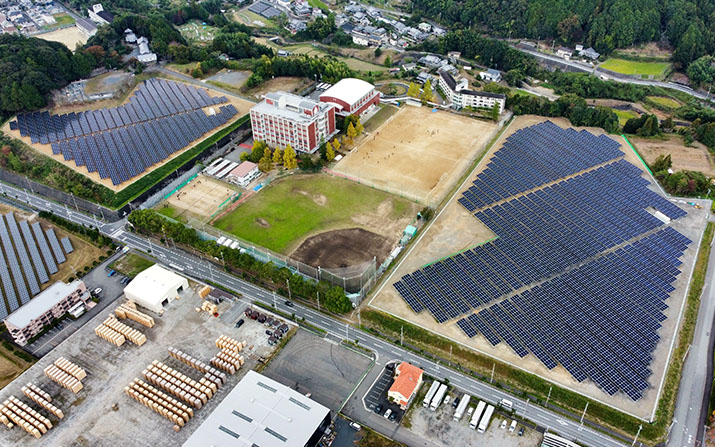
Our company has long upheld “environmentally driven” as one of its group management policies. It has been promoting the wider use of environmentally friendly renewable energy; specifically, it started operating the Nankai Tannowa Solar Power Plant at its own site in Tannowa, Misaki-cho, Sennan-gun, Osaka Prefecture, on October 14, 2016.
The company achieved 100% renewable energy operation by applying Kansai Electric Power’s Renewable Energy ECO Plan to the Cable Line on June 1, 2021 and to all six of our Limited Express Rapi:t trains on April 1, 2024.
In November of the same year, our group achieved its first carbon-free electricity utilization at Namba Parks and NAMBA SkyO by switching all electricity used at the facilities—including shopping centers and offices—to renewable energy. The renewable energy introduced was a combination of electricity delivered through self-consigned power transmission from the Nankai Ominedai Solar Power Plant as our group’s first attempt, with non-fossil tracking-certified electricity. The power plant was developed on the company’s own land in Hashimoto City, Wakayama Prefecture, with an annual generation capacity of approximately 6,000,000 kWh.
Issuance of the Integrated Report
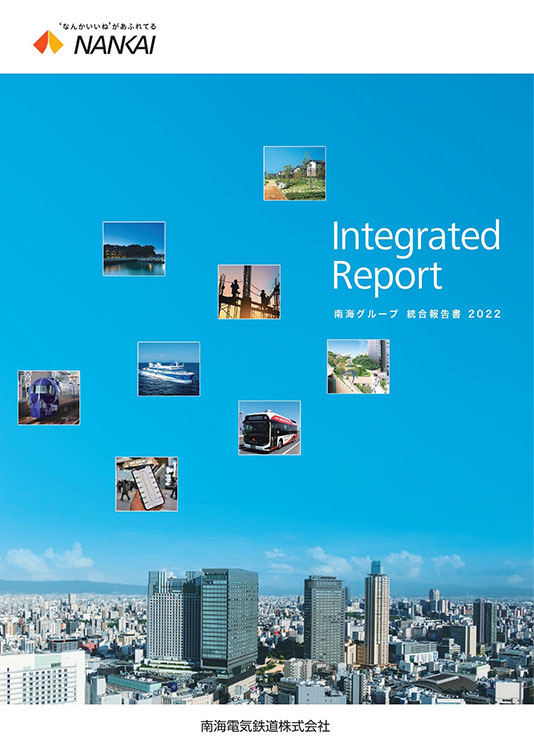
In September 2021, the company issued the Nankai Group Integrated Report 2021 as an alternative to the previous CSR reports to more effectively communicate our group’s path toward sustainable growth and value creation to stakeholders. This report incorporated non-financial information such as ESG data alongside financial information. Our integrated report has received high external recognition. In February 2023, it was selected as a “Most-improved Integrated Report” by external asset managers of the Government Pension Investment Fund (GPIF). These asset managers are entrusted with domestic equity management for GPIF. Moreover, it won an Award of Excellence at Nikkei Integrated Report Award hosted by Nikkei Inc. for two consecutive years from 2022 to 2023.
Transition to a company with an Audit & Supervisory Committee
Strengthening corporate governance functions is an important issue for achieving sustainable growth and increasing corporate value over the medium to long term.
The company transitioned to a company with an Audit & Supervisory Committee after the necessary amendments to the Articles of Incorporation were approved at the 104th Regular General Meeting of Shareholders held on June 25, 2021.
This granted auditors (including outside directors) voting rights on the Board of Directors, strengthening the board’s supervisory function and enhancing management transparency. Simultaneously, it delegated a portion of the board’s decision-making authority regarding business execution to directors, improving operational flexibility.
Results of the “FY2021 Management Plan”
In FY2021, the company achieved recurring cost reductions of 2.7 billion yen through business structural reforms such as organizational streamlining and outsourcing cost reduction. However, the impact of the COVID-19 pandemic was greater than initially anticipated. The company recorded net interest-bearing debt of 446.0 billion yen, meeting the target (456.0 billion yen), but operating income fell short of the target (15.0 billion yen) at 12.190 billion yen.