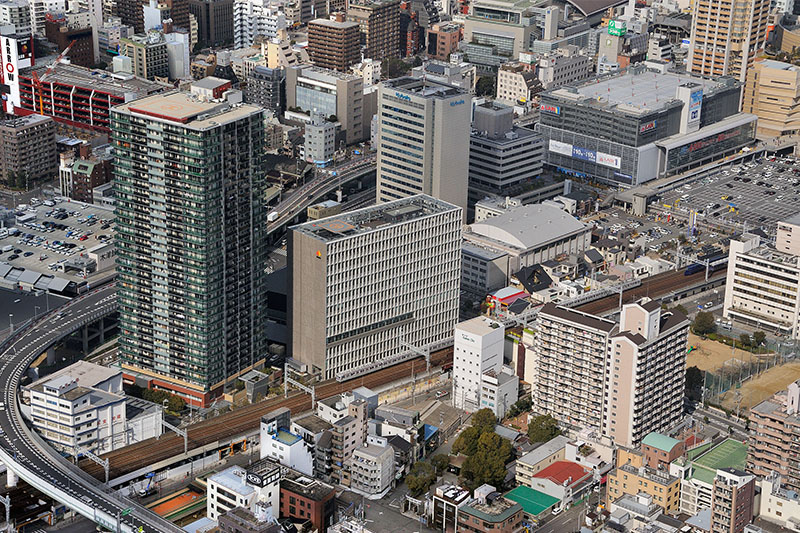

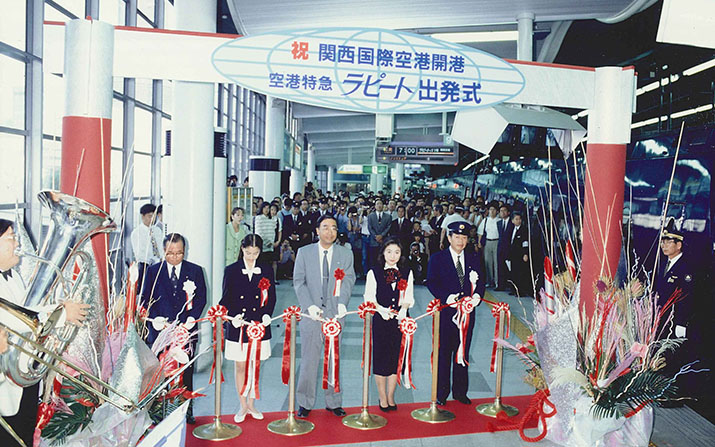
Namba Parks opened
In 1995, Nankai Electric Railway celebrated its 110th anniversary. Amid the prolonged recession following the collapse of the bubble economy, the company decisively reorganized and restructured its group companies while advancing the Namba district redevelopment project and making earnest efforts to become an integrated lifestyle company. It was the beginning of a new decade of confronting adversity and tackling business reform.
In the Namba district redevelopment, the Namba District Development Council was established in July 1989 based on an agreement among five relevant regional companies to jointly undertake town development. Subsequently, the Preparatory Committee for the Establishment of the Namba District Land Readjustment Project Association was formed in April 1992, and an application for establishment approval was submitted to Osaka City in June 1995.
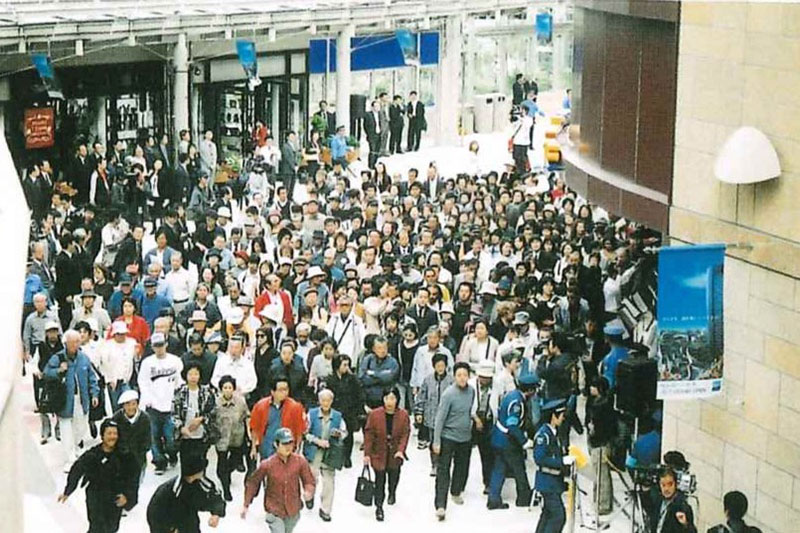
As preparations steadily progressed, in October 1998, Nankai Electric Railway merged with Osaka Stadium Enterprise, with whom the company had cooperated in advancing plans, establishing the framework to drive forward the Namba district redevelopment project. The Osaka Stadium, cherished by countless fans, was closed, demolished, and removed. Construction work on Area A-1 commenced the following year, in 1999. Nearly 17 years after the initial conception, the first phase of construction was completed. On October 7, 2003, Namba Parks, the new symbol of Namba, opened.
Meanwhile, the Nankai South Tower Hotel Osaka had been a symbol of Namba’s transition into a new era, but its international recognition remained low, leading to persistent operational challenges since opening. Consequently, in April 2003, it was decided to transfer the management of the hotel to Raffles International Limited, a company with global hotel brands, and a lease agreement was signed with it. In September, it was reborn as the Swissôtel Nankai Osaka.
Aiming to become an integrated lifestyle company
As an integrated lifestyle company, Nankai Electric Railway aimed to expand its directly operated food service and retail businesses. To this end, the company established a new subsidiary, the Nankai Food System, in 1995, starting to make earnest efforts.The new company opened its first convenience store, ANTHREE Nankai Namba Station Central Exit Store in 1997, and subsequently expanded its business operations step by step.
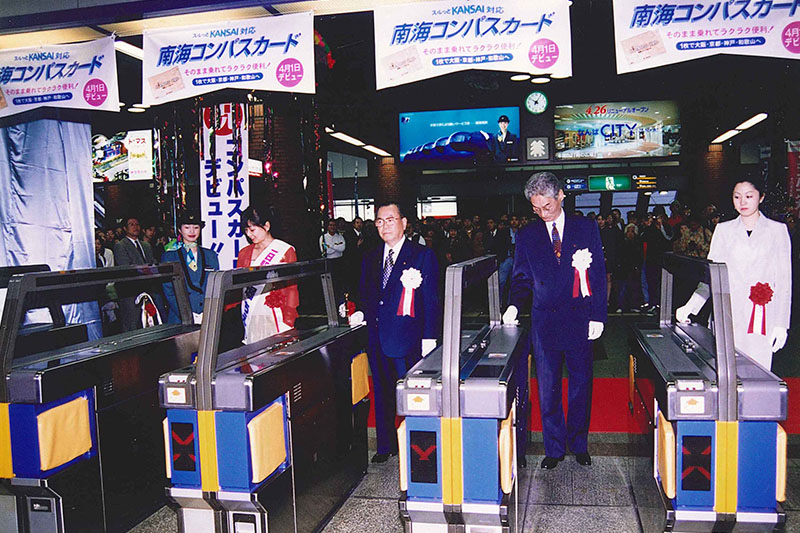
Meanwhile, in the railway business, Nankai Electric Railway launched the Nankai Compass Card, which was compatible with the stored-fare system, in April 1999, improving service quality and efficiency. The company worked on projects such as enhancing station convenience through barrier-free access, introducing new train vehicles, double-tracking the Koya Line, and implementing overpass projects on the Nankai Line.
In the housing business, the company began to sell building lots in Nankai Kumatori/Tsubasa-ga-Oka in 2000, followed by Nankai Rinkan Den’en-toshi Ayanodai in 2001 and Nankai Sayama Harmony Town and Nankai Sayama 2-chome Residential Area around the same time. Furthermore, the company entered the built-for-sale condominium business, starting with Nankai Amuzu Izumisano Uemachi in 1999.
Meanwhile, the construction of the Nankai Sakai Station Building began in March 1996. This became the company’s first full-scale office building, featuring not only station functions but also office and service facilities. The company also further expanded the Shop Nankai chain, opening new stores in Shin-Imamiya, Tengachaya, Tengachaya-Kita, and Kishiwada.
In the distribution business, Namba CITY underwent a major renovation ahead of its 20th anniversary in November 1998. Furthermore, in 2003, renovation work was carried out on the Namba CITY South Building. This enhanced the circulation of people between Namba Parks and Namba CITY, creating a lively atmosphere. Additionally, in July 2000, PLATPLAT opened next to Sakai Station. This created a unique shopping space featuring 45 specialty stores.
Taking on the challenge of reform
Group companies were reorganized and restructured. First, in October 1995, Nankai Construction merged with Tatsumura Gumi to become Nankai Tatsumura Construction. In October 1999, it was decided to liquidate three companies: Osaka Bay Ferry, Onigajo Tourism Development, and Kinokawaen. In February 2001, the three companies of Nankai Tokyo Building, Nankai Fudosan, and Nankai Home merged to form the new Nankai Fudosan. Furthermore, in March of the same year, Nankai Electric Railway transferred the management of seven taxi business subsidiaries that had suffered prolonged financial difficulties, withdrawing from the business.
In the bus business, facing a serious decline in ridership, the Nankai Electric Railway launched a new structure through complete spin-offs. In April 1999, the company established Nankai Wing Bus Kanaoka in Sakai City and Nankai Wing Bus Nanbu in Izumisano City, transferring operations for some routes to these entities. In May 2001, the decision was made to fully spin off the directly operated bus business, establishing Nankai Bus. Full transfer of operations was completed on October 1st. This was a decisive move for Nankai Electric Railway to fulfill its mission as a public transportation provider while escaping its loss-making structure and securing competitiveness.
Furthermore, amid diversifying leisure options and declining birth rates, the Sayama Amusement Park closed in April 2000 and was reborn as a new town. The Misaki Park established Nankai Amusement in June of the same year, entrusting it with the park’s operation and management. Aiming for a fresh start, it embarked on a new beginning.
The series of bold business reforms were implemented around Nankai Electric Railway’s 120th anniversary, extending not only to group companies but also to the company’s core businesses.
Advancing business restructuring and strengthening corporate foundations
In 2005, celebrating its 120th anniversary, Nankai Electric Railway formulated the Shinka 123 Plan (FY2005-2007) amid increasingly challenging business conditions, including declining birthrates and aging population. In November 2005, the company discontinued an intermediate station on the Wakayamako Line, which had seen declining ridership. In April 2006, the company transferred the operations of the Kishigawa Line, which had been operating at a loss, to Wakayama Electric Railway. Furthermore, the company integrated enterprises engaged in overlapping operations and closed firms showing no signs of improvement in profitability, aiming to enhance management efficiency.
In February 2006, the company launched the new group card service, the minapita, which featured a point-earning function. In July of the same year, the company introduced the IC card PiTaPa, which was provided by Surutto Kansai. Transportation IC cards, including PiTaPa, were successively introduced nationwide, and were made interoperable across Japan in March 2013.
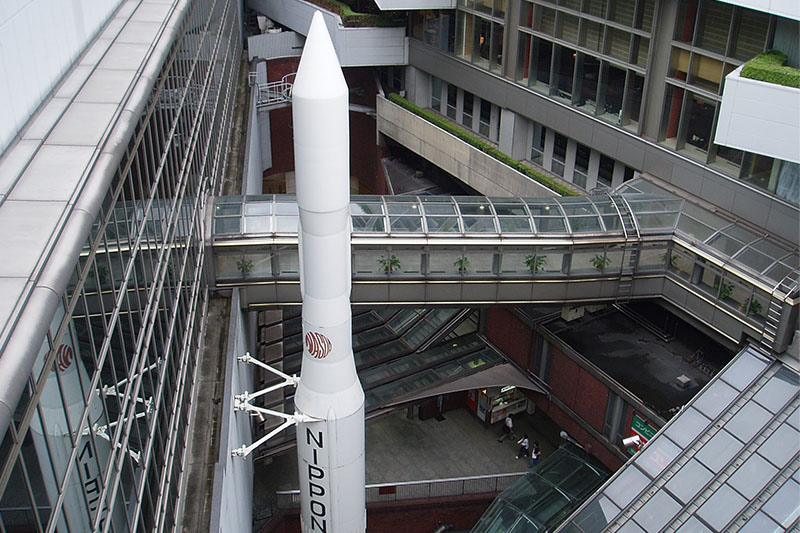
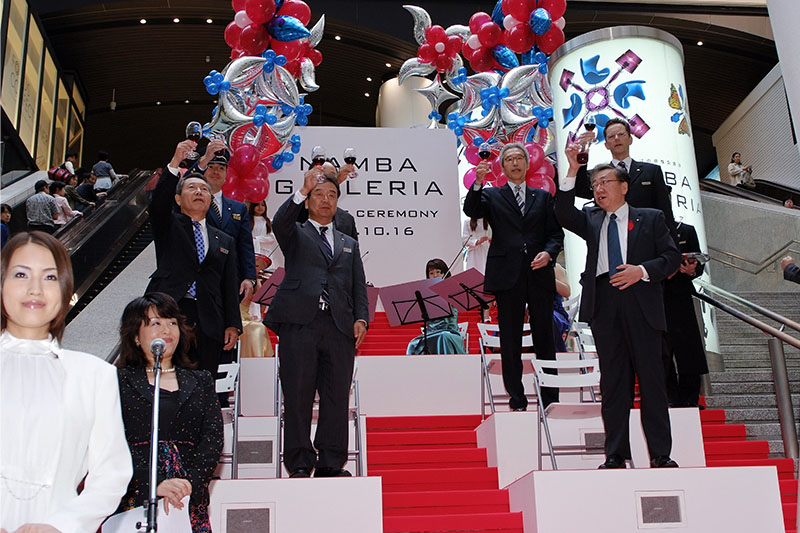
Meanwhile, in May 2007, the Namba Terminal Revitalization Plan was formulated, including the Nankai Terminal Building, which comprised the Nankai Building, Nankai Kaikan Building, Namba CITY, and Swissôtel Nankai Osaka, centered on Namba Station. As part of this plan, the rocket in the rocket area—a meeting spot beloved for 29 years since the opening of Namba CITY—was removed. A new area named NAMBA GALLERIA was created, becoming a new landmark in Namba.
In March 2006, Nankai Electric Railway partnered with Tear Co., Ltd. to enter the funerary business (operations of funeral halls), opening Funeral Hall TEAR in Hashimoto and other locations along our railway lines and in cities such as Hirakata. Furthermore, the company opened the new dolphin aquarium Shiny Stadium and the Waku Waku Train Land at Misaki Park, which celebrated its 50th anniversary in 2007.
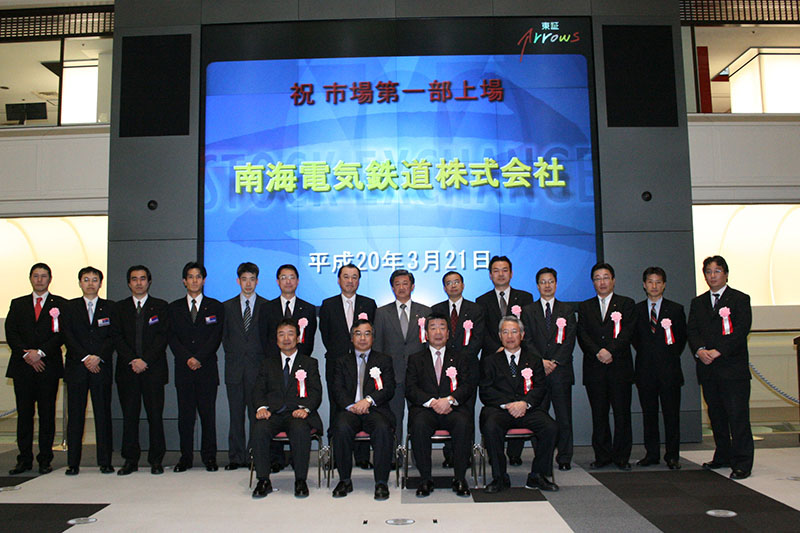
Under such circumstances, the company became listed on the First Section of the Tokyo Stock Exchange in March 2008, aiming to diversify funding sources and establish a robust management system. This listing marked the company’s first public offering in nearly half a century, representing a marked achievement, and it served to further strengthen the entire group’s awareness of corporate governance and compliance.
Responding to the anticipated increase in inbound tourism
In fiscal year 2007, the withdrawal from and restructuring of unprofitable businesses reached a turning point, and Namba Parks, the core of the Osaka Stadium redevelopment project, held its grand opening. While aiming to create an urban environment where people can spend fun time through initiatives like the expansion of Namba Parks Cinema, the new dining zone Namba Komejirushi opened to further spread the vibrancy, improving the circulation of people between the Namba CITY and Namba Parks. Thanks in part to the strong performance of the Airport Line, the numerical targets of the Shinka 123 Plan, which concluded in this fiscal year, were achieved.
The Kenshin 126 Plan (FY2008-2010), launched during a period of significant uncertainty for the Japanese economy due to factors like the strong yen, rising raw material costs, and the subprime loan crisis, was based on the fundamental principle of “fulfilling our corporate social responsibility while achieving steady business growth.” It addressed five challenges: (1) Strengthening environmental conservation efforts, (2) Improving the quality of services provided, (3) Further enhancing the value of the Namba area, (4) Accelerating the growth of promising businesses, and (5) Promoting revitalization along the railway lines. In September 2009, the company began publishing its “Nankai Electric Railway Corporate Responsibility Report,” which compiles initiatives to fulfill its corporate social responsibility.
In April 2009, to accommodate the anticipated increase in inbound travelers, the multilingual Information Center Namba was set up at Namba Station. This enhanced information provision for both domestic and international customers.
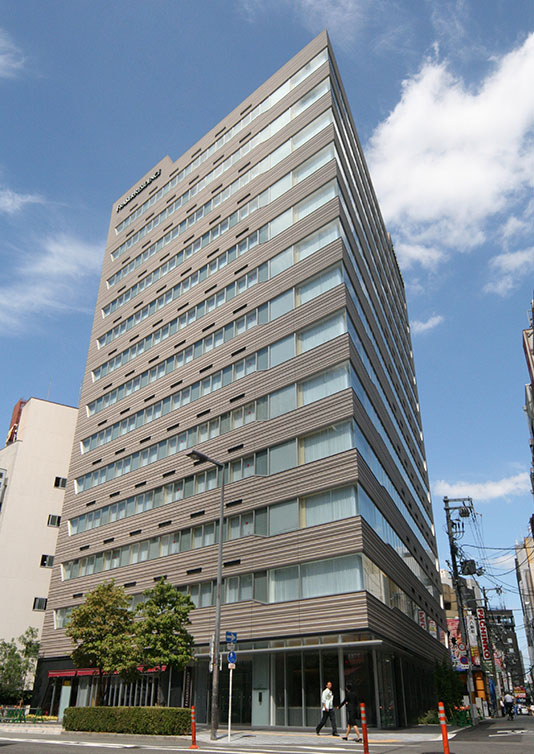
Meanwhile, in the real estate business, the serviced apartment Fraser Residence Nankai Osaka opened in October 2010 on the site of the former Hotel Nankai. During this period, the high-rise tower condominium Namba Tower Residence in Namba Parks was completed on land adjacent to Namba Parks in September 2007, and condominium buildings were also developed primarily along our railway lines. Urban development and residential land development also progressed in areas like the Nankai Rinkanden-entoshi Ayanodai in Hashimoto City, Wakayama Prefecture. Furthermore, to create a vibrant atmosphere in the Namba area, efforts were made to renovate Namba Parks and Namba CITY to maintain and enhance freshness and differentiate them from other areas.
Subsidiarization of Semboku Rapid Railway and the “Namba Terminal Revitalization Plan”
Despite the efforts, the Kenshin 126 Plan yielded disappointing results, falling short of all numerical targets including consolidated revenue and operating profit. In September 2008, the plan’s first year, the “Lehman Shock” triggered a global financial crisis. Domestically, political turmoil and a decline in Japan’s international competitiveness created a severe economic environment.
In light of these circumstances, the Rinshin 130 Plan (FY2011-2014) addressed five key challenges: (1) Promoting the tourism and inbound tourism businesses, (2) Expanding the real estate and distribution businesses, (3) Entering new business areas, (4) Driving the community development of Namba, and (5) Strengthening our Group’s management foundation.
In July 2014, Nankai Electric Railway acquired shares in Osaka Prefectural Urban Development Co., Ltd., a third-sector company funded by Osaka Prefecture and others, changing its name to Semboku Rapid Railway Co., Ltd., and making it a group company. Osaka Prefecture announced the sale of Osaka City Development Company in 2008. This presented an opportunity for our company to expand its business scope, and efforts continued to be made to acquire the shares. A public offering was conducted in 2013, and a foreign investment fund won the initial bid but was rejected by the Prefectural Assembly. In January 2014, Osaka Prefecture approached us with a renewed proposal. We increased our offer by 3 billion yen from the initial bid to 75 billion yen. As a result, the Prefecture expressed its intention to enter into a negotiated contract with us, leading to the signing of a share transfer agreement with Osaka Prefecture and others in May of the same year. Osaka Prefectural Urban Development Co., Ltd. operated not only railway services but also logistics businesses such as truck terminals (Higashi-Osaka, Kita-Osaka) and the shopping center Panjo in front of Izumigaoka Station. It was a significant investment for our company but was not exorbitant. Osaka Prefecture had requested an extension of the Nankai Koya Line during the construction of Semboku New Town, but our company had declined the request due to our financial situation and other factors. However, this led to the incorporation of Semboku Rapid Railway into our group.
Our environmental conservation efforts also progressed. In March 2012, the headquarters division obtained ISO 14001 certification. In January 2013, the office building of Nankai Namba Daiichi Building was completed, and the headquarters division relocated from the Nankai Kaikan Building. This marked the first relocation of the headquarters in 56 years since the completion of the Nankai Kaikan Building in 1957.
In July 2009, our company launched the sightseeing train Koya Hana Tetsudo Tenku on the Koya Line. Furthermore, the company collaborated with the popular anime series Mobile Suit Gundam from April to June in 2014, operating a red-wrapped Rapi:t train on the Airport Line to enhance the value of our railway services. Other initiatives included renovating stations and making them barrier-free, implementing continuous overpass, applying no-smoking policy to entire stations and Limited Express trains, introducing new energy-saving vehicle like the 8300 series, opening new stations such as Wakayamadaigakumae Station, and installing an Automatic Train Stop system (new ATS). Starting in December 2012, following a reduction in facility usage fees at Kansai International Airport, the Kansai Airport Special Discount Rapi:t Ticket went on sale. Online sales targeting overseas customers began in February 2014.
In January 2012, Nankai Electric Railway was selected as the management and operation contractor for the Tombori Riverwalk, a riverside promenade along the Dotonbori River, following a public tender by the Osaka City Construction Bureau. Our main contracted services included creating a lively atmosphere and providing maintenance and management services (cleaning and security). By attracting and hosting events, the company contributed to the revitalization of the entire Osaka Minami area.
Meanwhile, the “Namba EKIKAN Project” commenced to create new commercial spaces beneath the elevated tracks between Namba and Imamiyaebisu Stations. Aiming to foster interaction among customers, new commercial facilities began opening sequentially in April 2014. Furthermore, operations commenced at commercial facilities near Izumigaoka Station (Izumigaoka Center Building, Minami specialty store district) in August of the same year, marking the beginning of efforts to revitalize the Semboku New Town.
Furthermore, as the culmination of the Nankai Terminal Building Revitalization Plan, demolition work on the former Nankai Kaikan Building commenced in September 2014. Aiming to enhance the Namba area’s appeal, new construction began in September of the following year.
Through the series of initiatives, the final year of the Rinshin 130 Plan, fiscal 2014, saw operating revenue fall slightly short of the target, but also saw achievements such as a record-high ordinary profit, demonstrating steady progress in transforming the business structure.