

Formulation of the group’s human resources strategy
In order to realize the vision of “With our roots within the local communities, NANKAI with an entrepreneurial spirit is firmly committed to creating DiverCity in Kansai,” as outlined in our “Corporate Image in 2050,” to aim for the increase of value as a sustainable company, and to provide new value to society, human resources are our most critical management asset.
To further accelerate our human resource management initiatives, our group formulated the Nankai Group Human Resource Strategy in 2024.
The goal of implementing human resource strategy based on talent strategy—that is, investing in people—is to develop a workplace and staff in a way that enables each person to put their abilities to use. By achieving an environment where diverse talents can thrive, the company can achieve innovation in the Nankai style that captures and embodies the true needs of society and customers. This means responding to societal and customer expectations in every task regardless of scale, and ensuring the outcomes ripple out into business creation, enhanced value of existing operations, and operational reform. Achieving this requires accurately grasping what society and customers truly want and taking a practical and proactive approach to daily work.
Initiatives to enhance diverse expertise (introduction of career course system)
Our group is committed to securing and developing both human resources with managerial talent possessing business acumen/skills and human resources with expertise in specific operations. Furthermore, to strengthen the development of human resources with expertise, we introduced the career path system from FY2023. Employees can choose from the following three courses under this system: the Management Course, the Expert Course, and the Railway Professional Course. We promote development through suitable assignment and training plans for each course.
Flexible work arrangements for headquarters departments
To foster an employee-friendly environment and drive productivity gains through work-style reform, the company introduced a flextime system (allowing employees to choose their start time) and a half-day annual leave system in FY2019. Starting in FY2022, the company implemented a telecommuting system to enable employees to choose both their working hours and location.
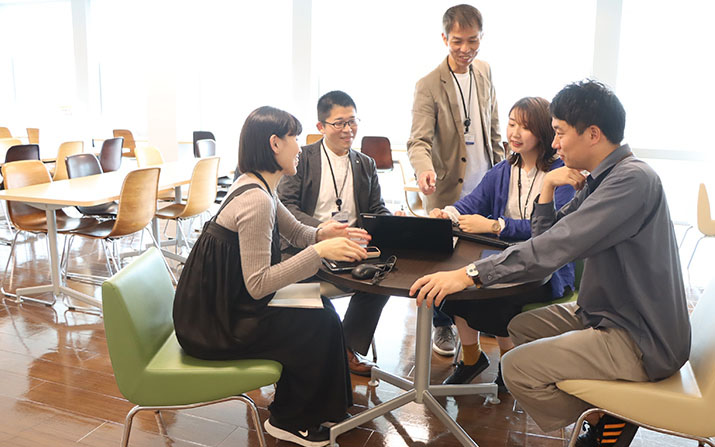
Furthermore, aiming to foster a culture of embracing new challenges and create a comfortable working environment, the company formally implemented a flexible attire system in the headquarters departments in May 2023. This allows employees to work in more relaxed attire, not limited to business attire (suits, ties, etc.). Meanwhile, for the free-address seating system, which had been progressively introduced across the headquarter departments since June 2020, a major renovation of part of the headquarters office floor was completed in July 2023. This renovation, centered on the keywords “connection,” “communication,” and “diverse work styles,” aimed to accelerate cross-departmental collaborative creation. In October of the same year, the employee cafeteria was also renovated to expand meeting spaces.
Promoting health management and childcare/caregiving support
To ensure all employees maintain both physical and mental health, the company established a Declaration on Health in June 2022. Concurrently, it launched the Health Management Promotion Committee to foster company-wide, cross-functional collaboration on health management initiatives. In 2025, the company was recognized as the 2025 Outstanding Organizations of KENKO Investment for Health (Large-Scale Corporation Category).
Furthermore, the company set the medium-term goal as providing the industry’s best working environment for people engaged in childcare, nursing care, etc., and senior employees. Starting in FY2019, the company expanded reduced working hours for childcare in operational departments. In FY2023, it introduced baby support leave (up to 10 days of paid leave available to both men and women during the postnatal period).
These initiatives resulted in female employees achieving a 100% usage rate of childcare leave and a 100% return-to-work rate after leave for ten consecutive years. Furthermore, the usage rate of childcare-related leave, including childcare leave, among male employees reached 97.7% in FY2024, maintaining a high level.